August 1845/1

Creative Commons License

Attics of the 21st century are different from attics of even the 20th century Hazel thought. Or was it just her grandmother’s attic that was different. No ancient carved wooden chests, no creaking old rocking chairs, no dark corners, no bookshelves up to the ceiling, not even very many old books. It was all a little disappointing in fact. Instead there was one metal filing cabinet, locked. One utilitarian but ugly computer desk partnered with a swiveling computer chair, again useful but not particularly attractive. The only mildly interesting attic inhabitants were the old fashioned computer keyboard on the desk, the equally old fashioned computer screen overlooking the keyboard, the bulky computer mouse keeping company with the keyboard, and the large ungainly desktop computer hiding beneath the desk. Hazel never understood why they were called desktop computers. In most of the image files she had seen of antique computers these plastic-metallic monstrosities were placed anywhere other than on a desk.

She pushed her sunglasses back down over her eyes, tapped the minmac on her wrist and by default the current date, time and weather conditions momentarily replaced the actuality of the attic. For a moment she was surrounded by the pouring and roaring of yet another spring storm but another tap and the storm disappeared into virtuality if not in reality. Well there was no point in going for an electrobike ride. This was her virtual school shift week and her next class was not for another couple of hours so she didn’t have to worry about lessons for a bit. And Edwin, her uncle was in virtual conference with his colleagues at the lab so she couldn’t go chat with him about his latest research. With a shrug she turned back to the old computer. It wouldn’t be quite the same as rummaging through chests in a musty attic but it was something to do to fill in the time.

The power cord was still connected to the computer so she plugged it in and flicked the power switch. A small LED on the computer casing glowed orange, she assumed that meant it was ready to go. Now she just had to find the power switch on the computer itself. After a couple of false starts, pressing peculiar extrusions on the casing she found one that actually moved when she pressed it. Immediately she heard a noise something between a murmur and a hum, the computer screen flickered and lights glowed on both the keyboard and the computer mouse. With a satisfied smile she sat in the chair, the start up routine of this antique was admittedly more exciting than the startup of the modern comtablets which started up as soon as you touched them, no lights, no noises, no anticipation.

An attractive image of a sunset filled the screen and in the middle of it she saw a small box which she assumed required some form of login information. Given that the computer had once belonged to her grandmother she typed in ‘Gwyneth’ only to get an error message telling her that the username was invalid. Frowning a little she tried the names of her father and those of his siblings, her aunts and uncles. None worked. Her frown deepened as her determination to gain access increased with her irritation, it should not be this hard. She stopped typing and glared at the keyboard. Then she noticed the small drawer hidden to the side of the computer desk and somewhat to her surprise it opened when she tried it. There was a bundle of papers in the drawer most of which seemed to be instruction manuals for old computer hardware and old computer programs. A date on one of the instruction manuals caught her attention, 2010. Her grandmother was born in the 2020s so maybe this computer did not belong to her grandmother after all.

Unlike many young people of her generation Hazel knew her whakapapa well. Perhaps this computer had belonged to her great grandmother Cara, not to Cara’s daughter. She typed in ‘Cara’ and almost immediately the screen blanked and a small spiral image appeared in the top left corner of the screen. Hazel recognised the image as a stylised koru, a symbol used by both cultural branches of her whakapapa – Māori and Celtic. A few seconds after the koru’s appearance a couple of lines of old computer style text formed in the middle of the screen, ‘You are not Cara. Please enter your own name’. Hazel went very still, suddenly aware that her heart rate had increased and there was a fluttery feeling in her stomach. Even as she shivered slightly she was speaking aloud to herself.

‘ Don’t be silly, of course it can’t know that I’m not Cara!’ Still she hesitated a little until, with a small shrug, she typed in ‘Hazel’.

This time nothing changed on the screen except for an apparent spinning of the koru symbol, then the sunset image returned and more text wrote itself on the screen.

‘ Username accepted. Version 1.3. Access available Folder 1’ and a single folder appeared in the center of the screen. She clicked on the folder. Nothing happened. Hazel was puzzled for a moment until she remembered that with most old computers that used mouse control a double-click was needed to open a file. She double-clicked.

A moving image of rain falling appeared on the screen. The background was dark and only the backlit streaks of rain were visible. As Hazel waited for something else to happen she became aware that she could hear the sound of rain. She was unable to discover where the sound was being generated from, however, there were no obvious sound devices in the attic. Smiling slightly, she realised that this must be one of the very primitive forms of senscoactivity applications that had been available in the first couple of decades of the century. They had been nothing more than a video combining visual imagery and sound files that was designed to elicit a sense of relaxation in the audience. They had been very popular for a while in the second decade of the 21st century but even then they were starting to be replaced with almost as primitive virtual reality technology. She wondered what her great grandmother would think about the virtual reality options of the present day. She was just about to close down what was turning into a slightly disappointing attic investigation when the world went away.
Time travel – to August 1845

At the same time as I rediscovered this blog three months ago, I bought myself a subscription to Scientific American (Sci Am). Many years ago I remember picking up Scientific American magazines in waiting rooms – doctor’s waiting rooms, lawyers’ waiting rooms, and even in the few coffee and tea rooms that actually encouraged their customers to relax and read while waiting for their lunch to arrive. I never had a subscription of my own however. Getting a subscription to an overseas’ publication from local shops was an iffy proposition. Apart from being very expensive, the magazines took weeks, sometimes months, to arrive at the shops and often didn’t turn up at all. And it was no better getting a mail subscription directly from the publisher. It could take one to two months to arrive in the letterbox. The joys of living in a small island country thousands of kilometres from anywhere!

Times have changed however. It is no longer necessary to wait for months for a magazine to be delivered to a local book store or to my letterbox, all I need is an annual digital subscription and I immediately have a pdf file of the entire magazine. I even have download access to the last four years of Scientific American issues. It sounds a little silly I know but I felt as if I had discovered an information treasure chest. That feeling returned tenfold when I bought myself a Scientific American monthly unlimited subscription. I now have download access to every single Scientific American there has ever been.

The first issue came out 28 August 1845, forty three years earlier than the first National Geographic – another magazine I now have a subscription for. According to Rufus Porter, who I assume was the editor then, Scientific American was a ‘family newspaper’ that ‘…will confer more useful intelligence to children and young people, than five times its cost in school instruction.’ A subscription cost $2 (USD) per year, half paid in advance and the other half in six months.

Did you know that in 1845, the Merrimack Company in Lowell, Massachusetts employed 1250 women in their textile mill, Apparently their average earnings exceeded $2 a week and that was after their board payments were removed from their pay packets. So, for those young women an annual subscription to Scientific American would have cost them a week’s wages (minus board). But wait. The average working man in the mill received 85 cents a day over and above their board. Given that the American working week in 1845 was at least 6 days (and the working day was between 10 and 12 hours long) that means that the men were getting about $5 dollars a week over and above their board. I suspect more men bought the magazine than women. Oh yes and the women (but not the men apparently) were fired if they were found guilty of ‘licentious conduct’ but less than 1% of the women lost their jobs for that reason. I wonder if that was because they were a particularly chaste lot or if they were just too smart to be caught.

Did you also know that the most up-to-date railroad car, also manufactured in Massachusetts, could hold up to 80 passengers and travel between 30 and 40 miles per hour? And then of course there was the visit of the first ocean-going iron-clad steamship, SS Great Britain, which was docked at New York at the time the first edition of Sci Am came out. She was a real crowd-pleaser and a huge attraction for the 2 weeks that she was in New York.

Imagine what it would be like to be able to travel back to August 28 1845 and see some of these things for myself…

…The room gradually darkens and eerie music starts playing…

Shadow in the Sand

Creative Commons License

The summer of 2018  in New Zealand was an extraordinary season. Temperature records seemed to break every day  and southerners took to the waters in numbers not seen for many years. But southern New Zealand humans were not to be the only visitors to the newly tepid southern beaches and harbours that summer.

Although not one of the scorchers of that month, January 2 was still hot by normal Dunedin standards. By late afternoon the tide was high, and the water pleasantly tepid after flowing in over sun warmed sand flats. Perfect conditions. I decided to take myself, my snorkeling gear, and my newest purchase, a tiny, waterproof video camera, down to the water to play. Others had the same idea so there was a decent crowd lolling in the water or kayaking around the communal boat jetty at the end of the street.  I chose a swimming spot a couple a hundred metres away from the rest, and, once suitably attired and accessorised, I slipped into the shallows and imagined myself a diver in a David Attenborough documentary, boldly investigating the ocean’s depths – all thirty centimetres of them.

During NZ summer Christmas periods, my siblings and I used to spend our holidays at the family crib (a holiday cottage for those who don”t understand southern NZ vernacular) close to the north eastern sand flats of Otago Harbour (Ōtākou). It was a long half hour drive from the city over a narrow and winding Portobello Road, good for pretty views of the harbour wildlife, bad for kids who suffered from car sickness. At high tide we would go swimming after having raced the incoming tide, at low tide we would be looking for flounders and crabs.

Decades later here I was in those waters again, drifting like a marine spy satellite over a busy little crab, who was probably wondering why the sun had suddenly disappeared, I was enchanted to find myself in the middle of a school of small silvery fish surfing the tide. My floating-in-watery-space act had fooled them into thinking I was just an odd shaped patch of kelp. On my moving the camera, parts of the school sheared to the left and right to avoid the suddenly animated kelp raft. I still managed to get some good video shots of them. I felt like I used to as a child, catching a glimpse of a Christmas present being wrapped just before Mum noticed me and shooed me away.

No photo description available.

I returned to documenting the journey of my little crab but it had taken the opportunity to leg it back to its home hole. I was looking for another documentary subject when a flicker made me look to the side. The rock shadow on the sand below me moved. About sixty centimeters across, with the barb on its tail clearly visible, a stingray was lazily twitching the tip of one wing , enjoying the light and warmth of that extraordinary day.

My initial flight-or-fight reaction was flight, get back to the safety of the shore before this marine beastie decided to whack me with its tail, but an unexpected burst of common sense stopped me. It was not at all disturbed by my presence so I accepted that as an invitation of sorts, given by one creature to another –  as long as you let me be you may share this space with me. I quietly re-positioned myself and filmed a magical few seconds as this graceful little cousin of the giant manta rays glided elegantly over the sand below me before disappearing into the sea grass forest.

Later that evening, while searching the web, I discovered that I had probably seen a short tailed stingray, common to northern NZ waters, not so common in southern waters. An unusually large number of stingray sightings were reported in the harbour that summer. That same month there was a crowded symposium of stingrays around Poor Knights Islands, the largest in about fifteen years.

Memory – Through a Glass Darkly

I mentioned in an earlier post that I had been a LiveJournal blogger many years ago. With a little help from a friend I re-discovered those old posts and came across one that puzzled me, Below is the post:

Jul. 8th, 2005 08:18 pm

This time next week I should be winging my way to the other side of the world for the first time ever. At this present moment I’m having an attack of nerves. Have managed to happily keep myself busy for the last week and have had no problem with nerves at all. And it’s taken about 24 hours for the shock of the London explosions to wear off. The reality of the thing has now risen to full consciousness. All of us in NZ know we’re lucky. We live on a set of temperate islands thousands of miles from the nearest landmass and we are neither economically nor strategically important enough for anyone to even really notice us. And we like it that way – it means we are relatively safe in these rocky times. And what do I have to go and do? I decide to go for a little wander to that side of the world in which all the big important countries wave to the heavens and yell “hey look everyone. Here we are ! Notice us!” And they do get noticed – boy do they get noticed! And what is really concerning – it makes no difference, I still want to go. Admittedly I have no plans to go to any big city anywhere but I’m still going to end up closer to hotspots than I would normally consider being. There’s this nutter pushing aside the sensible personalities saying “See, you thought you had escaped me all those years ago. Guess again chump, I’m still here and this time you are not going to stop me.” Oh well, c’est la vie.

And why did this puzzle me?

In my previous post, Snapshots of a Small City 1, I described the morning of the London bombings. When I wrote the essay in 2018 I had to search the net to remember what the date of those bombings was, I remembered that it was in July and in 2005 but I wasn’t able to remember the exact date. The 7/7 London bombings were – surprise, surprise – July 7 so I assumed that was what I was remembering from that long ago trip. Even when I wrote the piece in 2018 however, it seemed odd that I was in the US that early in July when I was under the impression that I had arrived there about mid-July. As it turns out, what I was remembering was not the 7/7 London bombings but the second, unsuccessful attempt at a bombing two weeks later. July 21

In one of the classes I teach we look at how accurate – or otherwise – our long term memories are. In that class we replicate a 1995 study by Roediger and McDermott in which students are shown six lists of words and are asked to recall as many words as possible after the list presentation. The words in each list are semantically related to each other. One such list contained the following words:

thread pin eye sewing sharp point prick thimble haystack thorn hurt injection syringe cloth knitting

Semantic relatedness means that within our memory these words are linked in some way. For example: ‘thread’ is related to ‘sewing’ as is ‘pin’ because both thread and pins are used when we sew. A pin is sharp and a thorn is sharp. We can get hurt if we are pricked by something sharp. This ability to find all sorts of relationships between things is very useful when we try to remember things but, it can also make it more likely that we will remember some things incorrectly.

In the final part of the experiment our students are shown words one at a time and asked to rate how confident they are that each word appeared in one of the six lists. About half the words are from the lists and about half are not but there were 6 words shown which, although they could have easily belonged to a list, were not actually members of the original lists. An example of one of these ‘lures’ is the word ‘needle’. Nearly every person who tries doing this experiment thinks they saw the word ‘needle’ in the list. Their own memory processes tricked them into creating a false memory.

The point is not that we have lousy memories it is rather that our memory doesn’t act like some sort of sound or video recorder, capturing everything about an event. We remember the important points of the event and when asked to recall the event later we reconstruct our memory of it based on those points. The important points are usually remembered well but to create a full bodied memory we add things. This was what happened to my memory of that day in Iowa CIty. In 2018 I clearly remembered staring silently at the TV with a group of fellow guests, I could even vaguely recall the layout of the breakfast room and the smell of, among other things, breakfast waffles, even after 13 years. I remembered that we were watching a news account of a bombing in London. I did not remember that it was the unsuccessful second bombing however. My memory reconstruction of that event was not accurate, I added information I found while writing that essay (the date of the 7/7 bombings) to my reconstruction of the Iowa City memory and in doing so the memory of the event ended up being shifted two weeks backwards in time. (By the way, I have edited the Iowa City essay in the interest of historical accuracy.)

Iowa City – July 2005

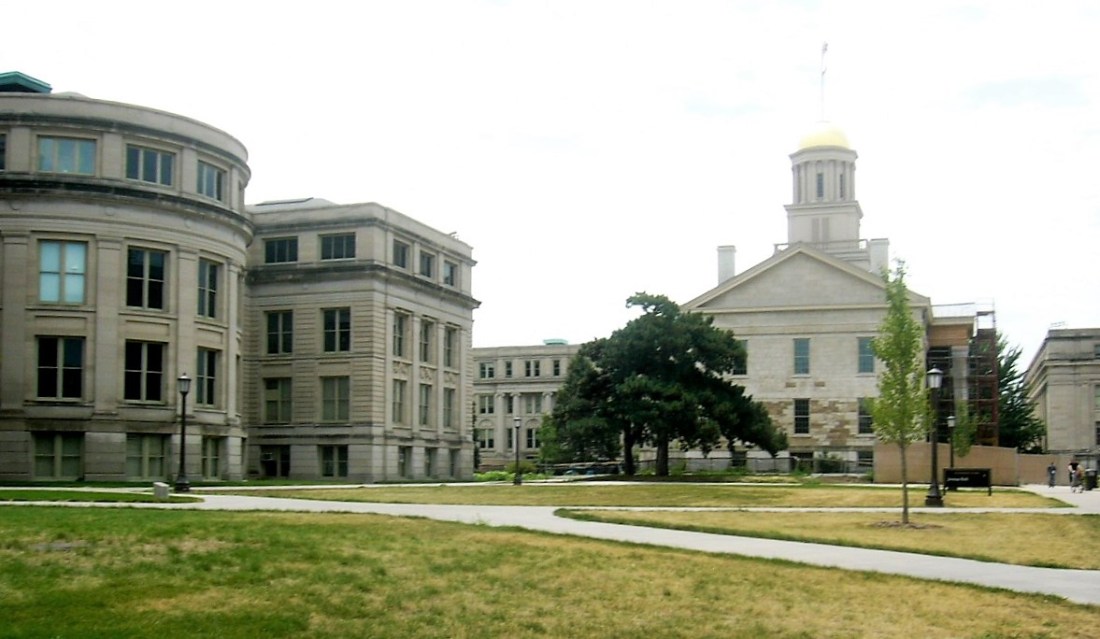
I have lived in New Zealand all my life – except for two weeks in 2005. I spent those two weeks visiting three cities in the United States of America. Two of the cities are smaller than my own city, one larger, and I thought them all wonderful in different ways. This particular post recalls memories from my five day visit to Iowa City in Iowa, USA. Although nothing to do with science this is probably my favourite essay that I have written for the science communication course. I believe it caught the essence of Iowa City better than any of my photos did.

For the record, according to google, the population of Iowa City is just under 74,000 people in 2021. The population of Dunedin in 2021 is about 134,000, although this number does seem to vary a little according to the source. Part of the reason for this variation might be that Dunedin, like Iowa City, is a university city and I’m not sure whether the 134,000 includes the over 20,000 Otago University students who live in the city during the academic year.

Snapshots of a Small City 1

Creative Commons License

This work is licensed under a Creative Commons Attribution-NonCommercial-NoDerivatives 4.0 International License.

Flying by night across the North American continent is amazing. Isolated pools of city light emphasize the huge size   of the darkened country below. We think of the United States as a land full of people, and it is, in the huge urban sprawls of the cities. But there is another America, one of small cities and even smaller towns, the places the young leave behind as they rush to find adventure in New York, Los Angeles, Chicago, and the other monster cities. Ten U.S, cities have over one million residents. But there are also over ninety cities in America about the same size as Dunedin, give or take a few thousand. On this clear evening, early July, in 2005, I am on my way to stay for a week in a city even smaller than Dunedin, Iowa City, the second largest city in the state of Iowa, U.S.A.

I leave just as the rest of the hotel’s guests are wandering in. I smile and nod at these friendly people who look no different to those I would greet at home. There is, however, one clue that I am not at home, some of the guests are being towed out the hotel door by their dogs, eager for an early morning walk.

There is a moment of disorientation as I step outside and I feel as if I have just walked through some peculiar Alice-Through- The-Looking -Glass portal although I can’t immediately identify the reason for the feeling. Then the light hits me. The foot path is white, not black. The road is also blessed with that same lack of blackness. The midsummer early sunlight hitting the white concrete of road and pavement has dazzled me for a moment. No wonder I feel like I’ve fallen into an alternate dimension, I’m seeing my normal world reversed like a photographic negative.

As I stand and look around I notice other looking-glass peculiarities. An ordinary blackbird flies by, there’s a flash of red-orange on its wing. Near me on the pavement is a quaint, metallic cylinder standing at attention like a large, red, toy soldier. I’ve seen these in cartoons, dogs raising their legs against them – fire hydrants. Another, bigger, bird flies past, peat black and glossy, a crow or raven, I don’t know which. And then, the real looking-glass moment is when I look over to the opposite pavement at dusty trees preparing for another heatwave of a day. On neatly trimmed, yellow green lawns, I see a grey-brown, bushy tailed little fellow staring curiously at me before scampering up one of the nearby trees. I am half a world away from my midwinter, frosty home of dark coloured roads, proper black blackbirds, and furry beasts that are not squirrels.

Over the following week there are other snapshots. Iowa City is a university town and the university sits in the middle of a web of very long, very straight streets that have no names, only numbers. These streets are invariably litter-free, and are lined with neat bungalows and villas with short lawns, well-behaved trees, and no fences. Many of the municipal buildings are built in the Georgian style of light coloured stone or concrete. On a sunny day during high summer, the buildings glow. Everywhere I go I can smell midsummer flowers although I never see where the flowers are. Once outside the city boundary, from horizon to horizon, all I can see are flat fields. By the end of the week I am surprised at how badly I miss seeing hills.

My favourite snapshots, however, are those of the people. The hotel manager, a kindly, soft-spoken man who calms me down when we discover that his machine won’t accept my NZ credit card.

Here are the two receptionists, one black and one white, who are delighted to discover that I am from the land where hobbits lived. Each day I return to the hotel they ask me about my adventures. They are intensely curious about New Zealand and about my reactions to their country. Neither of them will ever make enough money to be able to come over and see New Zealand for themselves.

There is the young man who opens the door of the store for me and says, “After you, ma’am,” without the slightest trace of irony.

Then there is the other young man in the Subway store who is getting annoyed at me when he can’t understand what I am saying.

‘What is a ‘toe-mar– toe? ’

Next to him is the young woman who glares at him and says, “She means ‘toe-may-toe’!”

And there is one more snapshot. It is captioned ‘Thursday, July 21, 2005’. There are tables laden with breakfast offerings but no one is eating. A dozen Americans of different hues and one New Zealander, browned by a week under a northern sun, are standing in front of a television on the wall. No one speaks as we watch the news coverage of a second attempted bombing of the London public transport system that had occurred while we had slept. Only two weeks earlier I had been in NZ watching the news coverage of the first set of July London bombings. Now I am on the other side of the world feeling like I am in some strange time warp. Once the initial shock and empathy with the Londoners fades a little I know we are all remembering another terror incident, four years ago. For these few moments I am not a visitor with a funny accent from a distant, exotic land, I am one of them. Culture and language may change from land to land but the things that make us human are the same wherever we may go. 

Charles Bonnet Syndrome: Through Amy’s Eyes

What follows is an essay about the circumstances that led me to an interest in science communication in the first place. The syndrome described here is estimated to be relatively common among those with limited vision, you can find a lot of information about it on the web. Unfortunately, in order to search for information about it you need to know the syndrome exists. This essay is the result of my frustration that when Amy started seeing things no one told any members of the family about this possibility and by the time I did find out about it, our initial belief that Amy was suffering from dementia had tainted her trust in us. Had we known about it earlier the last five years of her life might have been easier for all involved. The original version of this essay was written for a science communication assignment.

Amy

Creative Commons License
This work is licensed under a Creative Commons Attribution-NonCommercial-NoDerivatives 4.0 International License.

The deterioration may have begun after a botched cataract operation in her mid-80s, or it may have been age related macular degeneration, a common cause of vision loss as we all grow older. Most probably it was a mixture of both. Whatever the reason Amy’s vision deteriorated gradually through her late 80s to her mid-90s. It started off as a loss of detail in her central vision, faces of her friends and relatives looked blurry, the paintings on the walls lost detail, and most importantly, books became more and more difficult to read. Slowly she lost the ability to recognise colours or to see her own face in the mirror. All her hobbies relied on her ability to see. She loved reading murder whodunnits, painting pictures, knitting, and writing limericks but by the time she reached her mid-90s all these were no longer possible. She did listen to music and to audiobooks. She also continued making the once five-minute walk to the nearby supermarket to pick up the Listener magazine she could no longer read and the cakes that she always had available for the relatives and friends who regularly visited her. I was one of those visiting relatives, the second youngest of her nieces.

We were friends as well as aunt and niece, sharing a love of reading and writing. I found it hard to watch the shrinking of her once vibrantly visual world. It was even harder for Amy who had to experience that shrinking every moment of every day. But there was another, more insidious problem, that concerned me and the rest of the family about Amy, she appeared to be showing signs of dementia.

Amy had started seeing things. Lights appeared on the road outside her house. She thought they belonged to a car that for some reason always decided to park there at night. A couple of times she saw a cat jump down from her bed, she thought that a neighbour’s cat must have got into the house. On several occasions, she even saw two people in her room at night, a man and a woman. She tried confronting them one evening but they didn’t answer her and apparently just left. Amy became more convinced that there were other people living in her house, squatters of some kind. The problem was that although the stories Amy devised to explain what she insisted she saw sounded delusional there were no other indication that she was suffering from some form of dementia. Her memory and her reasoning remained as sharp as ever. Like a detective in one of Amy’s favourite whodunnits I was stumped. I couldn’t understand how she could have dementia without showing the more commonly described symptoms. The clue to solving the case came one evening I arrived for dinner.

After dinner, as Amy and I were talking she mentioned that she was having some problems with her eyes, something of an understatement I thought given the state of her vision. She asked if it was normal to see grid lines on the ceiling. As the conversation continued, she also mentioned that she sometimes saw other geometric patterns on the ceiling and walls. She knew that what she was seeing could not be real, but it puzzled her why she was seeing these things. Once I got home that night, I did a search of the internet and discovered that existence of Charles Bonnet Syndrome (C.B.S.).

C.B.S. is characterised by two main symptoms, the presence of hallucinations alongside the presence of progressive vision loss. It tends to be more common among the elderly, probably because a larger proportion of that age group suffer from progressive vision loss relative to younger age groups. Unlike the hallucinations that accompany neuropsychological disorders like dementia or psychoticism, those with C.B.S. are usually aware that what they are seeing is not real. The hallucinations seen vary in complexity. The patterns on walls and ceiling seen by Amy were of the least complex kind while the hallucinations of the cat and the people in her house were more complex examples of the C.B.S. hallucinations.

The currently accepted theory about why C.B.S. occurs is called deafferentation theory. This theory is based on the idea that processing visual stimuli from the external world inhibits the brain’s production of random, internally generated hallucinatory images. As there is less visual input to process with increasing vision loss, there is less inhibition of the random visual processing within the brain. It is this random visual processing that is thought to cause the hallucinations.The important point is that C.B.S. hallucinations are physiologically based, they are not the result of disorders in thinking like those often associated with the dementias.

Amy spent the last three years of her life in a rest home and then in a nursing home. As her vision continued deteriorating her hallucinations became more and more complex and it became more difficult for her to recognise that what she was seeing was not real. C.B.S. paired with feverish deliriums resulting from frequent urinary tract infections, meant that Amy’s world became increasingly separated from the world in which the rest of us lived. But it doesn’t need to be this way.

C.B.S. is a diagnosis of exclusion which means that it is only diagnosed after all other possible causes have been ruled out. The most recent estimation of the prevalence of C.B.S. is about 30% of the population suffering from some form of vision loss. No one knows for sure how many there are however. The fear of being thought ‘crazy’ understandably prevents many people, especially the elderly, from talking about the hallucinations to family or to their doctors. The hallucinations of C.B.S. are not normally frightening and for anyone whose vision is so bad that they cannot normally see, the clarity and variety of the hallucinations could be a pleasant alternative to the visual monotony associated with their vision loss. For this to happen however, C.B.S. needs to be recognised by both the public and the general medical establishment as a peculiar phenomenon associated with physiological vision loss. A 2018 Canadian study found that 74% of the family doctors surveyed were unaware or just slightly aware of the existence of the syndrome. This suggests that nearly three quarters of general practitioners would be unlikely to even consider the possibility of C.B.S. when faced with an older patient describing visual hallucinations, they would be more likely to reach the same conclusion we did with Amy, that the patient was showing signs of dementia.

The take home lesson? Should you or any member of your family start seeing fairies flying around your room or, more commonly, lines of ladies or gentleman in formal Victorian attire marching in front of you, don’t automatically assume that you are going crazy. If you know or suspect that your eyesight is worsening for any reason, at least consider the possibility that you are dealing with C.B.S. Think of it as your brain saying to you “Hey I know that your eyes are no longer working too well for you, so here is a gift from me to you. Sit back and enjoy the show.’

Introducing Zsyquay and Blog (a.k.a. The Science Attic)

I started this over three years ago. It was a suggested exercise for a science communication course I was taking but I never did anything with it beyond setting it up. It is now 2021, I have finished the course and the world is in the midst of a pandemic.

Today I remembered this poor, abandoned little blog and decided to give it another go, it will give me somewhere to write between my bouts of at-home working during a second New Zealand lockdown. I can also learn about playing the serious blogging game as we go along.

When I set up this blog in 2018, I was teaching at university and trying to keep up with science communication assignments – we had an essay to write every couple of weeks – so I had little time for a project that

1) Did not contribute marks to my course and
2) I had little enthusiasm for.

Just to clarify Point 2:

I was 57 years old and although I had been using computers for work and fun for nearly 40 of those years I was old-fashioned (and arrogant?) enough to think that blogs were not for ‘real’ writers. A little ironic given that I had got into blogging in the early 2000s as one of the LiveJournal community. (Unfortunately I can no longer remember even my account name for LiveJournal, much less my password so all those journal entries are now nothing but digital archaeological relics.) So this nascent blog languished in digital limbo until today.

Today, this blog and I renew each other’s acquaintance and will try to journey together at least a little ways. Although the intention is for this to be a mostly science-oriented digital attic the odds are that I will digress at times. Forgive me if I do so, you are quite welcome to put it down to the cognitive waywardness of a not-quite-yet senior citizen who loves talking, and loves writing even more. And should you feel the urge to join Blog and I every now and then, you are very welcome to do so.

The Journey Begins

Thanks for joining me!

This blog was set up in July 2018. It is now August 2021, three years on and eighteen months into a pandemic, and I am going to finally start this journey. You are welcome to come along for the ride, who knows where it might lead!

Good company in a journey makes the way seem shorter. — Izaak Walton

post